March 27, 2026
I wake up at 9:30 am, which means I will probably have an exhausting day, given that I went to bed well after 4 am. Well, on the first day of travel, you keep your expectations moderated. But I feel suspiciously good …

Bangkok — Taling Chan

Bangkok — Taling Chan

Bangkok — Taling Chan
I was able to sleep well, as it was utterly peaceful at night. The frenetic barking that greeted me upon arrival yesterday night quickly dissipated. I am surprised I slept so well on the hard mattress, but following the amount of time I just spent on airplanes and the time zones I crossed, perhaps I shouldn’t be!

Bangkok — Taling Chan

Bangkok — Taling Chan

Bangkok — Taling Chan
I just hope that the inexpensive hotels I book in Thailand don’t have awful mattresses, the likes of which traumatized me traveling at the end of last year in Northeast Asia. I also still remember the amazingly comfortable mattresses I experienced in rural Cambodia when I traveled through the region in 2010 — in one of the poorest countries on the continent, the beds are entirely handmade, which turned out to assure a stellar sleeping experience.

Bangkok — Taling Chan

Bangkok — Taling Chan

Bangkok — Taling Chan
I don’t have clear plans for the day, but the general idea around my return to Bangkok would be to explore the area on the left bank of the Chao Phraya river, which I am hoping has more character and sense of intimacy than the excessively commercialized and touristed right bank. Sure, there are areas that have genuine character, such as Dusit, but a lot of it is ultimately quite regrettable, catering to the ilk of tourist I really want to have nothing to do with. The one drawback I can see from the map is that there are limited rapid transit connections in my area, the lines focusing primarily on the east side of the river.

Bangkok — Taling Chan

Bangkok — Taling Chan

Bangkok — Taling Chan
I have to make a point of learning some Thai on this trip. I have been so remiss with learning languages on my travels over the years!

Bangkok — Taling Chan
Bangkok — Taling Chan

Bangkok — Taling Chan
I am not incredibly hungry, probably the aftereffect of being fed regularly on the flights and not being able to do much to burn the calories off. An Airbnb such as the one I am now staying in normally doesn’t include prepared food, but the host has taken it upon herself to make a breakfast that I find on the divan outside presented in prim plastic containers, and includes sublime stewed pork, white rice, a small tub containing a sunny-side-up egg, and subtly-spiced stewed vegetables. The food is quite incredible, but I still need to buy groceries today.

Bangkok — Taling Chan

Bangkok — Taling Chan

Bangkok — Taling Chan
It is early afternoon when I leave the compound I am housed in, the run down temple to the immediate right now quiet, a few dogs lurking inside the grounds, but without the nocturnal aggression. I walk in the alley to the left of my compound, along the narrow passage running to the canal, where I am offered a sweeping view of the settlement that abuts the canal. There are no high rise towers here, only clusters of houses ranging over no more than a few levels. The architecture is simple, mostly sprawling wooden bungalows with small lots adorned with myriad potted plants and trees and household appliances.

Bangkok — Taling Chan

Bangkok — Taling Chan

Bangkok — Taling Chan
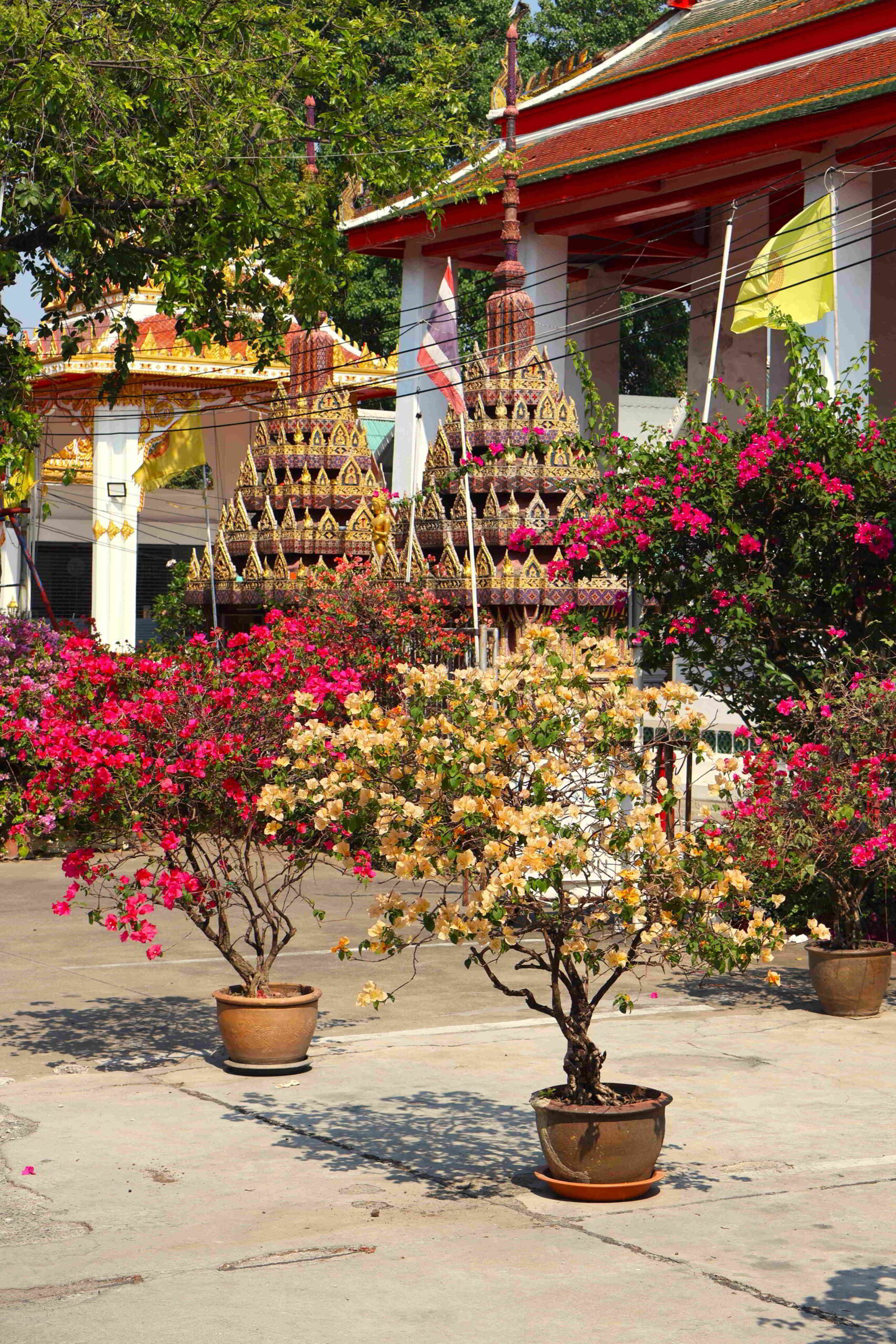
The area is far from ostentatious, but evidently comfortable, with spacious private residences home to families that both live and eke small livelihoods out of their homes. I see no activity on the river, and that could be a testimony to the idea that Thais are an industrious people, everyone being off to work somewhere. But no matter: the small terraces draped with colourful potted bougainvillea and looming frangipani trees are a pleasure to behold, driving home the reality of being in Thailand again. And the weather is perfect; sunny, hot, with evidently manageable humidity.

Bangkok Noi — Siriraj Piyamaharajkarun Hospital

Bangkok — Taling Chan — Princess Maha Chakri Sirindhorn Anthropology Centre

Bangkok — Taling Chan
Just on the side of the bridge I was dropped off yesterday evening is a hole-in-the-wall coffee shop that represents another welcome return to the Thailand I remember from years ago, the shelves packed with an alternating array of merchandise and whimsical, themed decor, cigarettes, action figurines, tea canisters, a wall covered in fridge magnets, a testimony to the vibrant imagination that Thais bring to such a humble establishment. But the coffee and fresh juices the radiant owner makes are top calibre — welcome to Thailand! I chat with her, but need to continue in the direction of the floating markets this area of the city is known for.

Bangkok Noi

Bangkok Noi — Chao Phraya

Bangkok Noi
A visit to my first Buddhist temple on the trip, Wat Chang Lek, by local standards far from outstanding, although each temple has its unique qualities in terms of the sizing of the constituent pavilions, their decorative details, and their organization. Trimly-tiled roofs crown the ubosot, wihan, and other structures, sequences of identical gilt nagas lining the roof edges, fluted golden finials rise from the cardinal points of the gables, the gable facades decorated with sinuous bas-relief gilt floral motifs. The whitewashed pavilion walls are lined with a sequence of majestic windows, each flanked with elaborately detailed columns and crowned with naga-encased arched pediments enclosing more elaborate gilt detailing.

Bangkok — Taling Chan — Wat Chang Lek

Bangkok — Taling Chan

Bangkok — Taling Chan — Wat Chang Lek
The adjoining area is solidly residential, the houses crammed into the little available space without interleaving gaps, but despite the modest pretentions, there are glimpses of aesthetic prowess, ranging from elaborately carved metal gates to daintily-arranged potted plants, spray of colourful bougainvillea, oversized picture windows looking out over overgrown vegetable plots, spacious verandahs, and occasionally larger gardens.

Bangkok — Taling Chan Floating Market

Bangkok — Taling Chan Floating Market

Bangkok — Taling Chan Floating Market
There is little human activity around the Taling Chan floating market, as it has wound down for the day, but the essence of the market and its attraction is still very visible, the series of vendors assembled on the floating pier preparing local food specialties, grilled meats and fish, all for surprisingly modest prices, the remaining clientele a mixture of farang and locals. This would be a perfect place to eat, but I have no appetite, and am happy to maneuver along the narrow passages on both sides of the floating market to take those perfect shots. Occasional long boats carrying tourists putter by on the canal, the boats available for hire at the various piers running eastward toward the main river. The market may have roots in tradition, but the primary income today is from the farang that venture beyond the standard fare of the shopping malls and Khao San road to experience a more authentic side to the city.

Bangkok — Taling Chan

Bangkok — Taling Chan Floating Market

Bangkok — Taling Chan Floating Market
The river market extends onto land, a long covered channel lined with vendors whose stands are still very much in business for the day, a trickle of mostly locals perusing the wide assortment of snacks, condiments, fast foods, souvenirs, knickknacks, and so on, the rectangular area bordered by shrubbery and flowering bushes, the degree of landscaping an evidently far cry from the aesthetic embellishments afforded a far more authentic local market. The boundary of the market is established by the canal on one side, a group of administrative buildings on the east side, the commuter train track on the west, and vehicular roads on the north side. On the main road, awnings shade a series of shallow terraces emanating from a set of modest eateries, while next door sits a 7-11, my next destination.

Bangkok Noi — Chao Phraya

Bangkok Noi — Chao Phraya
I had read that you can buy prepaid SIM cards at the 7-11, but entering the outlet before me offers a far more complicated experience. They definitely have prepaid SIM cards, quite cheap in fact, but given the low prices and fact that no information is posted about the total data capacity included with each card makes me skeptical. The staff don’t speak English, I don’t speak Thai, and worse, they have no idea as to what I am talking about. In my usual guileless mode, I wheedle local customers to helping me out, and a younger woman with her son now triage between myself and the employees, the back and forth seeming to go nowhere until they take notice of a poster showing that the 30 day prepaid SIM card sells for ฿199, which includes 30 GB of data.

Bangkok Noi — 72nd Anniversary Park

Bangkok Noi — 72nd Anniversary Park
That can’t be — for effectively CAD $8.50? I contrast the price with the some $80 the equivalent was selling at the airport. I had wanted to purchase an eSim from AIS, but their cards are not available at the 7-11, only those of DTAC, whose services apparently works well in the smaller towns in the Isan that I intend on traveling to. That said, for the trivial price I am paying, it won’t make much difference — as long as the service works!

Bangkok Noi — Chao Phraya

Bangkok Noi — Chao Phraya
East along Chak Phra road, wider than the alleys I have emerged from to the west, lined with private residences with gardens, the structures solidly built and well-maintained far beyond what would be conceivable in the area closer to the canal, luxurious apartment buildings, elegant cafes, institutional buildings, banks, medical facilities, and of course, another temple complex, this one far more expansive, with larger buildings and more ornate workmanship. I continue on, intrigued by the evolving urban landscape, the narrow alleys leading northward to Borommaratchachonnani road — one of the main east-west arteries of Taling Chan – flanked by spacious, anodyne lots dominated by clusters of shining white apartment towers.

Bangkok — Taling Chan — Princess Maha Chakri Sirindhorn Anthropology Centre

Bangkok — Taling Chan — Princess Maha Chakri Sirindhorn Anthropology Centre

Bangkok — Taling Chan — Princess Maha Chakri Sirindhorn Anthropology Centre
My next destination is the Princess Maha Chakri Sirindhorn Anthropology Centre, an imaginatively-designed complex that gives credence to the notion that Bangkok actually features diverse and sophisticated cultural institutions that the vast majority of visitors overlook for the more prosaic if not tawdry environs of Khao San, Rama I, and Sukhumvit roads. There certainly are no tourists at this cultural institute, although it does only feature some exhibitions of minor local modern artists. The architecture is part of the draw through, its imaginative structure standing in stark contrast to the bland, homogenous residential and office towers it is surrounded by.

Bangkok — Taling Chan — Princess Maha Chakri Sirindhorn Anthropology Centre

Bangkok — Taling Chan — Princess Maha Chakri Sirindhorn Anthropology Centre
The spacious garden offer a pleasant respite from the overheated conflagration of the city, its majestic trees replete with welcome shade, sculptural arrangements, and a creatively-adorned pond pleasing to behold from the comfort of the terrace. Glass walls enclose the soaring, air conditioned interior, with its expansive shelving and display cases, a small bar serving coffees, teas, and cold drinks, and upstairs, an extensive exhibition on Thai society and culture, and a reminder of the rich tapestry of the country’s identity that has largely been subsumed by modernization. A grid of placards describes each of the historical ethnicities of the country, wall-mounted displays and floating podiums display illustrations and arts and crafts pertaining to the traditional cultures.

Bangkok — Taling Chan — Princess Maha Chakri Sirindhorn Anthropology Centre

Bangkok — Taling Chan — Princess Maha Chakri Sirindhorn Anthropology Centre
Having completed the afternoon’s walk through the Taling Chan neighborhood, I would like to continue to a different area, namely the waterfront of the Bangkok Noi district, effectively across the river from the royal palace. I would like to take public transit there to be a more responsible visitor, but despite singling out several different bus lines that apparently pass from my current location to my destination, the buses never arrive according to the Google Map schedule, and finally I give up in frustration — there are effective and inexpensive options, although weaving along the crowded streets and flying along the fast-paced highways of Bangkok on the back of a motorcycle taxi would probably be outside the comfort zone of most visitors. But the two-wheeled transport is very effective inasmuch as you can weave through traffic without stopping, unliked cars that are slowed by continuous gridlock.

Bangkok Noi — Wat Amarinthraram Worawihan

Bangkok Noi — Wat Amarinthraram Worawihan

Bangkok Noi — Wat Amarinthraram Worawihan
The riverside may feature an almost nonexistent lateral road network, so it’s very expedient that an elevated roadway runs almost directly eastward to the confines of the Chao Phraya river, the exit conveniently looping to the entrance of the Wat Amarinthraram Worawihan, a royal monastery dating to the Ayutthaya period (ca. 1657), rebuilt by King Rama I in the Rattanakosin era. The pavilions in the temple are grandiose and the degree of craftmanship utterly dazzling, but also beholden to a very unique decorative style involving mosaics of colourful ceramic pieces that are unique to this area.

Bangkok Noi — Wat Amarinthraram Worawihan

Bangkok Noi — Wat Amarinthraram Worawihan

Bangkok Noi — Wat Amarinthraram Worawihan
This style of ceramic mosaic decoration is historically known as Krueng Charn or Khrueang Cham Charoen and is used to decorate the prangs and walls of temples in Bangkok such as Wat Pho and Wat Arun. Designs are composed using broken or purposefully-cut pieces of Chinese porcelain, ceramics, and colored pottery plates, bowls, and tiles, shaping them into delicate floral motifs (Lai Thai), leaves, and intricate patterns. A signature motif of this style features white ceramic petals layered into multi-tiered flowers, often finished with a bold red center. This style was popularized during the reign of King Rama III (1824–1851), when Chinese trading ships brought vast quantities of ceramic goods and porcelain ballast to Siam. Instead of discarding broken porcelain, artisans repurposed it into weather-resistant architectural ornamentations. The ceramic shards are set directly into a damp stucco/mortar layer on the building or chedi surface, creating a 3D, tactile relief effect that catches the sunlight.

Bangkok Noi — Wat Amarinthraram Worawihan

Bangkok Noi — Wat Amarinthraram Worawihan
The temple has other unique characteristics, such as the wedding cake-style prangs topping several of the structures, the muted green and yellow hues of the decorative detailing (in contrast to the typically bolder red, emerald, and gold colour schemes), the guardian lions flanking entrances, prang-shaped pediments over doorways, the tooth-like Bai Raka decorations running along the edge of the bargeboard (lamyong) representing naga or garuda feathers, and the elaborately-carved nagas lining the roof edges. In stark contrast with the temple, the enormous rectilinear structure lying closer to the waterfront is bustling with activity, a continuous flow of people and vehicles coming and going from the Siriraj Piyamaharajkarun Hospital, one of the city’s flagship private hospitals, then onward to the riverfront, where I am greeted by a rare instance of tasteful urban planning in the city centre on any scale.

Bangkok Noi — 72nd Anniversary Park

Bangkok Noi — 72nd Anniversary Park

Bangkok Noi — 72nd Anniversary Park

Bangkok Noi — 72nd Anniversary Park
The core of the waterfront project is the 72nd Anniversary Park, recently created for the current king, and a refreshing green sanctuary in the core of the city, the grounds a blend of walkways, landscaped shrubbery, and flowering frangipani trees, offering atmospheric views of the junction of the Chao Phraya and Bangkok Noi rivers, the latter originating from the Taling Chan area to the northwest. Taking advantage of a rare traffic-free setting, throngs of locals walk and run along the paved paths centering on a Buddhist-style pavilion, lined with the remains of the walls of an ancient fort, and to the rear, the Siriraj Bimuksthan Museum. The park abuts the Thonburi Railway Station Pier, while across the Bangkok Noi lie the wooden bungalows of the exclusive CHANN hotel next to one of the major attractions of the city, the Royal Barges National Museum. And as with anything along the immediate riverfront, getting there without a boat is far from easy …

Bangkok Noi — 72nd Anniversary Park

Bangkok Noi — 72nd Anniversary Park

Bangkok Noi — 72nd Anniversary Park

Bangkok Noi — 72nd Anniversary Park